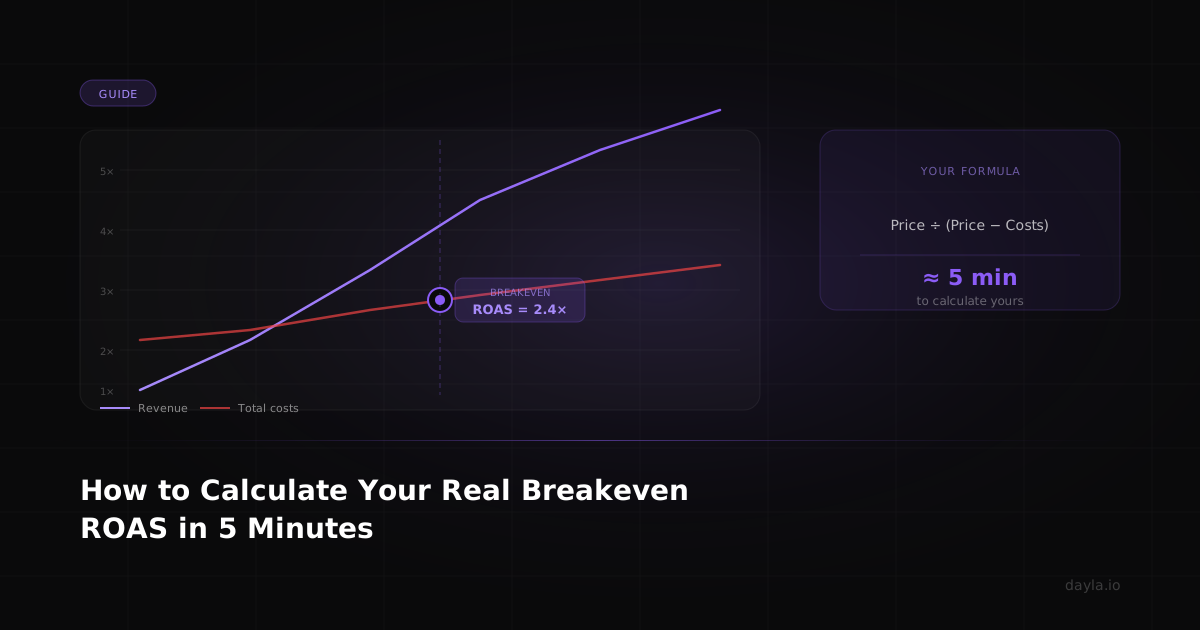
What breakeven ROAS actually means
Breakeven ROAS is the minimum return on ad spend you need to cover all your costs and not lose money on a sale. Below this number, every sale you make through ads is a net negative — you're paying to lose money.
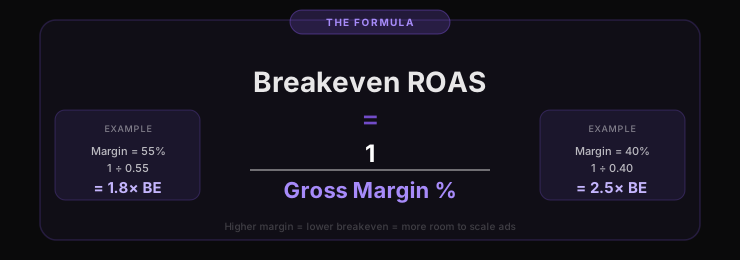
Most brands either don't know their breakeven ROAS, or they calculate it incorrectly by only using product cost. The correct calculation includes every cost associated with fulfilling an order.
The correct formula
Total Non-Ad Costs = Product cost + Shipping + Payment fees + Platform fees (pro-rated) + Return rate impact + Any other variable cost
Example: You sell a product for $60. Your product costs $18, shipping is $6, payment fees are $2, and other costs add up to $4. Total non-ad costs = $30.
This means you need at least $2 of revenue for every $1 of ad spend just to break even.
Common mistakes that give you a false breakeven
Mistake 1: Forgetting returns. If 20% of orders are returned, your effective revenue per order is lower. Adjust by multiplying revenue by (1 − return rate).
Mistake 2: Using COGS without shipping. Many brands calculate COGS as just the product cost, forgetting inbound and outbound freight, customs, and 3PL fees.
Mistake 3: Not accounting for platform fees. Shopify's percentage-based fees and your app stack cost real money per order.
Mistake 4: Using blended ROAS but platform-specific costs. If you're calculating breakeven for Meta specifically, use the Meta spend — but compare it to total revenue, not just Meta-attributed revenue.
Turn your breakeven into a scaling rule
Once you know your breakeven ROAS, you have a rule: any campaign running above breakeven is profitable to scale. Any campaign below breakeven needs to be paused or fixed before you touch the budget.
A useful framework: set your target ROAS at 1.3× your breakeven. This gives you a 30% buffer for variance, tracking discrepancies, and the costs you forgot to include. If your breakeven is 2.0×, don't scale a campaign until it's consistently hitting 2.6×.
What a healthy breakeven looks like by AOV
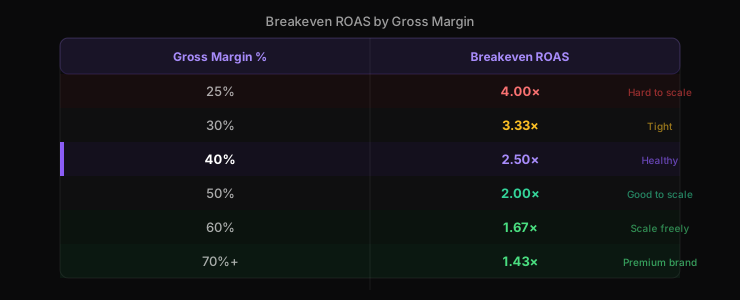
Breakeven ROAS is not a fixed number — it varies by product margin and AOV. A brand selling a $200 product with 65% margins has a breakeven of 1.54×. A brand selling a $30 impulse product at 40% margins has a breakeven of 2.5×. Both numbers are fine — what matters is knowing yours.
As a rough guide: if your breakeven ROAS is above 3.5×, you have a margin problem to solve before scaling ad spend. At that level, the slightest campaign performance dip puts you in the red. Focus on reducing COGS or increasing AOV first.
Rastrea tu beneficio real con Dayla
Deja de pilotar tu e-commerce a ciegas. Dayla conecta tus datos y calcula tu beneficio neto real en tiempo real.