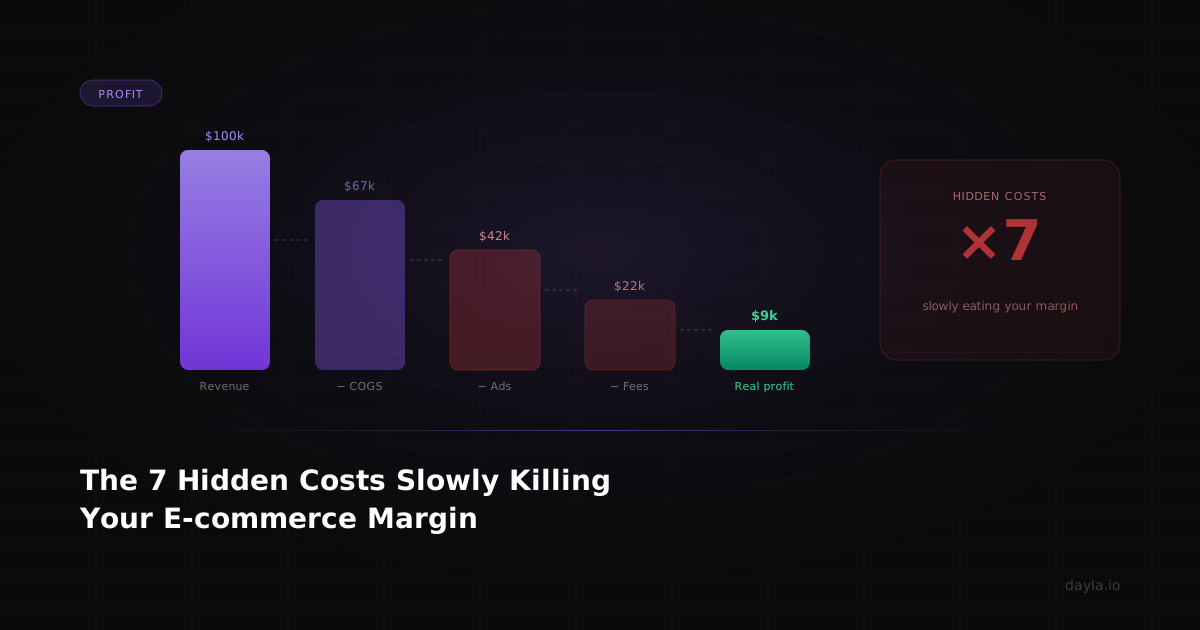
Why your gross margin is an illusion
Most e-commerce dashboards show you revenue and sometimes gross margin (Revenue − COGS). But gross margin excludes a long list of costs that are just as real as your product cost.
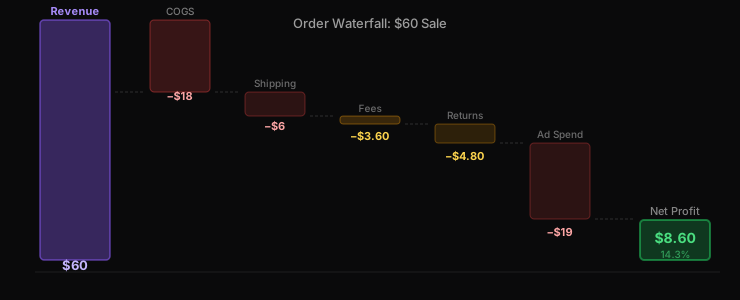
If your product costs $18 and you sell it for $60, your gross margin looks like 70%. But after ads, Shopify fees, payment processing, returns, and shipping, your real net margin might be 8–12%. Some brands run at negative margin without realising it.
The 7 costs most brands forget to track
1. Payment processing fees: Stripe/Shopify Payments takes 2.9% + $0.30 per transaction. On a $60 order, that's $2.04, 3.4% of revenue gone before you touch it.
2. Platform fees: Shopify Basic is $39/mo, but apps, themes, and integrations often add $200–500/mo in hidden SaaS costs.
3. Return and refund costs: The average DTC return rate is 18–25%. Each return costs you the original shipping, return shipping, restocking labour, and often the product itself.
4. Chargebacks: Beyond the refund, each chargeback carries a $15–25 dispute fee. If 0.5% of orders result in chargebacks, that's a meaningful hit on thin margins.
5. Packaging and inserts: Branded boxes, tissue paper, thank-you cards, and inserts are often excluded from COGS calculations, but they're real costs.
6. Warehouse and fulfilment: 3PL fees include receiving, storage per cubic foot, pick-and-pack, and outbound shipping. These often add $3–8 per order on top of product cost.
7. Customer acquisition amortisation: The cost to acquire each customer should be spread across their lifetime value. Brands that think only in one-order ROAS are perpetually underfunded.
How to find your true unit economics
Build a simple per-order waterfall: Start with revenue, subtract COGS, subtract shipping/fulfilment, subtract payment fees, subtract pro-rated platform costs, subtract pro-rated ad spend, subtract return rate impact.
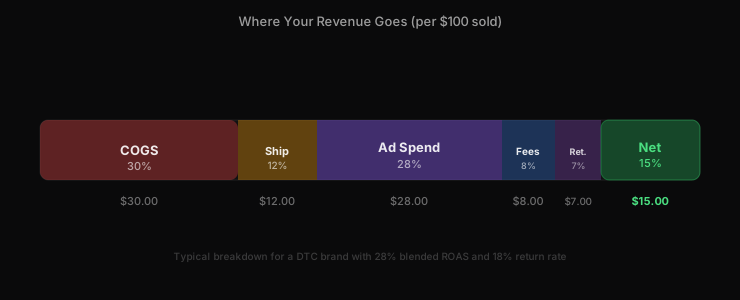
Whatever is left is your real net profit per order. For most brands running at healthy margins, this should be 15–25% of revenue. If it's below 10%, you have a margin problem, not a revenue problem.
Automate the tracking so you see it every day
The reason these costs stay hidden is that they live in different systems: Shopify, Stripe, your 3PL portal, your ad platforms. Nobody connects them automatically.
Dayla pulls all of these costs into a single P&L view per order, per SKU, and per channel. When you sell a product, you see the full cost waterfall in real time, not three weeks later when you reconcile your spreadsheet.
Which costs to fix first
Not all hidden costs are equally fixable. Payment processing fees are essentially non-negotiable (unless you move to a different processor or qualify for Shopify's lower rates). But return rates, packaging costs, and app stack bloat are all highly optimisable.
Start with returns: a 5-percentage-point reduction in return rate (say from 22% to 17%) directly improves every unit economics metric, margin, LTV, and effective ROAS. Then audit your app stack. Most brands are paying for 3–5 apps they barely use. A $200/month app that saves 2 hours per week is not always worth it at $50k/month revenue.
Suis ton vrai profit avec Dayla
Arrête de piloter ton e-commerce à l'aveugle. Dayla connecte tes données et calcule ton profit net réel en temps réel.